IF ZOMBIES ATTACKED RIGHT NOW WHAT WOULD YOU DO? This was one of my friends' favorite conversation topics starters in college. It's a great question!
That being said, let me preface this post with saying that I hate scary movies - especially zombie films. Seeing 28 Days Later scarred me. I hate zombies. Sometimes when I'm driving around empty fields I have a vision of zombie hordes coming over them towards me and my heart jumps. It's irrational, I know, but God, I hate zombie films.
However, a few nights ago over a couple martinis, a friend explained to me that (good) zombie films are more than just "Scary Movies." Classic zombie films are actually a form of social commentary. (Apparently this is common knowledge, but I never got close enough to the subject to learn that.)
For example, a stereotypical scene in a zombie apocalypse situation is the human "survivors" taking refuge in a shopping mall, taking the useful things and watching the zombies stumble around the department stores and kiosks.
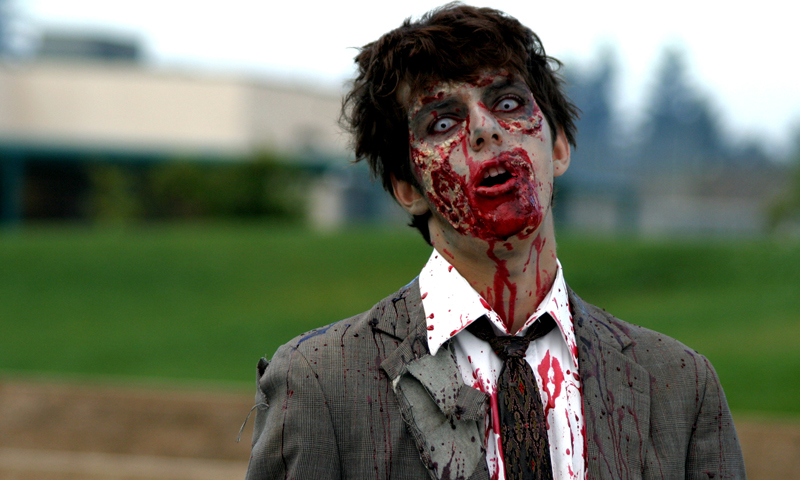
Or, the survivors are in a fortress of some sort while the zombies are either shambling outside or clamoring to get in. The fortress represents the "First World," the zombies any less-well-endowed people or marginalized group. Separate storylines, or perhaps even the main storyline, is concerned with the formation of a social power structure within the survivors.
Last night I watched three - three - episodes of The Walking Dead, a well-liked show on AMC. It's a lifetime achievement for me. Although the zombie threat and the accompanying violence was quite the scare-off, I ended up really enjoying watching the survivors' group dynamics. For example, members of two historically marginalized groups (blacks and women) were mistreated by undereducated, Southern white males and were swiftly avenged by two level-headed law enforcement officers (well, that's what they were pre-zombie takeover). Interesting...
That night, I slept poorly and dreamt of zombies, but with a lot less fear than I was used to. :-) I have more respect for the zombie genre and look forward to catching up on the classics.
P.S. Have you heard of the new trend of zombie camps?
Sunday, December 11, 2011
Wednesday, December 7, 2011
Preserve the Land, or Build On It?
I maintain a blog for the organization I work for, the Indiana Association of Soil and Water Conservation Districts. I try to make it as relevant as possible for as many people as possible. Here's a good one:
The Central Indiana Land Trust received a grant of 40 acres from the Eller family. The land is located in fast-growing Fishers, IN, just north of Indianapolis. According to an article in the Indy Star, Van Eller turned down offers to sell to residential developers. (Between 2000 and 2007, Fishers' growth was more than double that of Indianapolis. Undeveloped farmland is very valuable to developers in high-growth areas.) Eller didn't want to see the land that had been in his family since the 1830s fall into the hands of suburb developers. Instead, he gave the land to the Central Indiana Land Trust. The 40 acres will become a nature preserve.
"Such land donations have become more popular since the downturn in the economy as property values have dropped and landowners seek to take advantage of federal tax breaks.
In Indiana over the past five years, there has been an increase of 64 percent in the acreage set aside for preservation, according to the first census of land trusts conducted on a national level by the Land Trust Alliance, which released its findings last month." (Indy Star).
Urban sprawl, also known as suburban sprawl, is a multifaceted concept, which includes the spreading outwards of a city and its suburbs to its outskirts to low-density and auto-dependent development on rural land, high segregation of uses (e.g. stores and residential), and various design features that encourage car dependency. [1] ... The term urban sprawl generally has negative connotations due to the health, environmental and cultural issues associated with the phrase.
While building suburbs and roads as fast as possible may be immediately profitable, preserving areas of undeveloped land are important to the overall health of our communities and of our environment.
What do you think?
Subscribe to:
Posts (Atom)
