IF ZOMBIES ATTACKED RIGHT NOW WHAT WOULD YOU DO? This was one of my friends' favorite conversation topics starters in college. It's a great question!
That being said, let me preface this post with saying that I hate scary movies - especially zombie films. Seeing 28 Days Later scarred me. I hate zombies. Sometimes when I'm driving around empty fields I have a vision of zombie hordes coming over them towards me and my heart jumps. It's irrational, I know, but God, I hate zombie films.
However, a few nights ago over a couple martinis, a friend explained to me that (good) zombie films are more than just "Scary Movies." Classic zombie films are actually a form of social commentary. (Apparently this is common knowledge, but I never got close enough to the subject to learn that.)
For example, a stereotypical scene in a zombie apocalypse situation is the human "survivors" taking refuge in a shopping mall, taking the useful things and watching the zombies stumble around the department stores and kiosks.
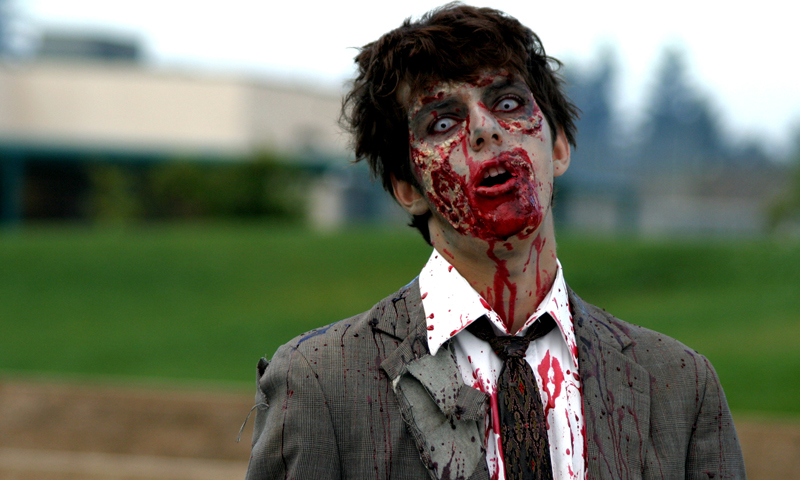
Or, the survivors are in a fortress of some sort while the zombies are either shambling outside or clamoring to get in. The fortress represents the "First World," the zombies any less-well-endowed people or marginalized group. Separate storylines, or perhaps even the main storyline, is concerned with the formation of a social power structure within the survivors.
Last night I watched three - three - episodes of The Walking Dead, a well-liked show on AMC. It's a lifetime achievement for me. Although the zombie threat and the accompanying violence was quite the scare-off, I ended up really enjoying watching the survivors' group dynamics. For example, members of two historically marginalized groups (blacks and women) were mistreated by undereducated, Southern white males and were swiftly avenged by two level-headed law enforcement officers (well, that's what they were pre-zombie takeover). Interesting...
That night, I slept poorly and dreamt of zombies, but with a lot less fear than I was used to. :-) I have more respect for the zombie genre and look forward to catching up on the classics.
P.S. Have you heard of the new trend of zombie camps?
Sunday, December 11, 2011
Wednesday, December 7, 2011
Preserve the Land, or Build On It?
I maintain a blog for the organization I work for, the Indiana Association of Soil and Water Conservation Districts. I try to make it as relevant as possible for as many people as possible. Here's a good one:
The Central Indiana Land Trust received a grant of 40 acres from the Eller family. The land is located in fast-growing Fishers, IN, just north of Indianapolis. According to an article in the Indy Star, Van Eller turned down offers to sell to residential developers. (Between 2000 and 2007, Fishers' growth was more than double that of Indianapolis. Undeveloped farmland is very valuable to developers in high-growth areas.) Eller didn't want to see the land that had been in his family since the 1830s fall into the hands of suburb developers. Instead, he gave the land to the Central Indiana Land Trust. The 40 acres will become a nature preserve.
"Such land donations have become more popular since the downturn in the economy as property values have dropped and landowners seek to take advantage of federal tax breaks.
In Indiana over the past five years, there has been an increase of 64 percent in the acreage set aside for preservation, according to the first census of land trusts conducted on a national level by the Land Trust Alliance, which released its findings last month." (Indy Star).
Urban sprawl, also known as suburban sprawl, is a multifaceted concept, which includes the spreading outwards of a city and its suburbs to its outskirts to low-density and auto-dependent development on rural land, high segregation of uses (e.g. stores and residential), and various design features that encourage car dependency. [1] ... The term urban sprawl generally has negative connotations due to the health, environmental and cultural issues associated with the phrase.
While building suburbs and roads as fast as possible may be immediately profitable, preserving areas of undeveloped land are important to the overall health of our communities and of our environment.
What do you think?
Wednesday, November 16, 2011
National Geographic Photo Contest
Here's a collection by the Atlantic. There are large, high-resolution photos there. You can also click on any of the photos below to open them up into a little hover screen where they'll be larger and prettier. :-)
Here are some of my favorites:
| Climbing the Harding Ice-field trail in the rain has its rewards. I stopped to admire glacier, only to find an adult black bear eating in front of a glowing blue glacier. (© Colin McCrindle) |
Monday, November 14, 2011
"Is Homeownership All It's Cracked Up to Be?" The Changing Face of Housing in the US
According to Trulia, a real estate website, buying is still cheaper than renting in 74% of the 50 largest US cities. It's truly a buyers' market - think of the foreclosed Vegas condos you could buy for a fraction of what their original owners paid! The Chicago Tribune reports that in Detroit, you can buy a whole house for $7,500 (notable, albeit on the extreme end of affordability). If enough people get together to commit to buy a block or two of houses, sections of Detroit could become veritable neighborhoods, if not just communes. Sounds like a great business plan...
Homeownership has been part of the American Dream for quite some time. Homeownership is seen as an investment, a money-maker, and a means of establishing your personal and financial stability. The idea of owning a home is so inspiring that a slew of well-funded, long-standing nonprofits - i.e. Habitat for Humanity and Rebuilding Together - are founded upon the idea of providing a home to those who couldn't otherwise afford them. The idea is so inspiring that it also led policy-makers to permit banks to make home loans to people who can't repay them, led houses to be overvalued so that buyers would believe their "home investment" was gaining in real value - or paying more to begin with - and other things that led to the crises over the past few years.
In June 2010, Sheila Bair, president of the FDIC, broached the idea that maybe - just maybe - homeownership is not for everyone. Not everyone can afford one, not everyone is ready for the responsibility of owning a house, etc. (College isn't for everyone either, despite common belief.)
Additionally, homeownership seems to represent the opposite of what the experts say is necessary in this new world economy. Instead of loyalty and steadfastness, the market is looking for flexibility in jobs and locations. Owning a home ties you to an area's shifting economy; those who bought houses in Las Vegas in 1995 are affected of that city's dramatic downturn, and since their mortgages are under water, most can't afford to leave to find a new job. Tight spot.
The US economy has been changing rapidly, and what worked for prior generations' realities might not work out for this one. Healthcare, education, employment, transportation, and housing are all experiencing drastic changes and new philosophies are cropping up all over the place. What's been your experience? What's your outlook?
Read "The Anxiety of the Forever Renter" (via the Atlantic Cities) for a great reflection on the writer's personal struggle to decide between renting and buying.
For now, I'm renting, and expect to continue doing so for the foreseeable future. I like the flexibility, I like indulging my restlessness, and I like being able to walk away from a bad situation or towards a better one. The benefits are outweighing the disadvantages at the moment.
Homeownership has been part of the American Dream for quite some time. Homeownership is seen as an investment, a money-maker, and a means of establishing your personal and financial stability. The idea of owning a home is so inspiring that a slew of well-funded, long-standing nonprofits - i.e. Habitat for Humanity and Rebuilding Together - are founded upon the idea of providing a home to those who couldn't otherwise afford them. The idea is so inspiring that it also led policy-makers to permit banks to make home loans to people who can't repay them, led houses to be overvalued so that buyers would believe their "home investment" was gaining in real value - or paying more to begin with - and other things that led to the crises over the past few years.
In June 2010, Sheila Bair, president of the FDIC, broached the idea that maybe - just maybe - homeownership is not for everyone. Not everyone can afford one, not everyone is ready for the responsibility of owning a house, etc. (College isn't for everyone either, despite common belief.)
Additionally, homeownership seems to represent the opposite of what the experts say is necessary in this new world economy. Instead of loyalty and steadfastness, the market is looking for flexibility in jobs and locations. Owning a home ties you to an area's shifting economy; those who bought houses in Las Vegas in 1995 are affected of that city's dramatic downturn, and since their mortgages are under water, most can't afford to leave to find a new job. Tight spot.
The US economy has been changing rapidly, and what worked for prior generations' realities might not work out for this one. Healthcare, education, employment, transportation, and housing are all experiencing drastic changes and new philosophies are cropping up all over the place. What's been your experience? What's your outlook?
Read "The Anxiety of the Forever Renter" (via the Atlantic Cities) for a great reflection on the writer's personal struggle to decide between renting and buying.
For now, I'm renting, and expect to continue doing so for the foreseeable future. I like the flexibility, I like indulging my restlessness, and I like being able to walk away from a bad situation or towards a better one. The benefits are outweighing the disadvantages at the moment.
Sunday, November 13, 2011
"House of Cards:" The Changing Face of Housing in the US, Part 1
Part 1: Foreclosed Homes
This NYT article explores a unique manifestation of how houses left over from the "foreclosure crisis" are being used. In Merced, CA, the University of CA has run out of student housing (a common occurrence at my alma mater, another large state school) and has reached an agreement with the abandoned house owners (banks, generally) to allow students to live there, paying rent instead of a mortgage. Although they're in subdivisions, the homes are luxurious, and the university sends busses to cart them back and forth from campus.
While I can't help but feel some envy for these students (I've lived in my fair share of funky, run-down college-town rentals), I'm also delighted at the unique symbiotic partnership that's come out of such a bad situation. Best of all, it seems perfectly legal and, for a time, sustainable.
In Florida, housing scams are nothing new (read The Orchid Thief for a thrilling tale of lies, deceit, and inhuman beauty). They're a time-honored tradition in that state. Unsurprisingly, the foreclosure crisis hit Florida hard and left many empty homes and subdivisions, and a wealth of bankers and individuals with expensive, unused real estate on their hands. Also, there are a lot of homeless people in Florida (it's warm most of the year). Could a symbiotic relationship be created to solve both of these groups' problems?
Take Back the Land, an organization based in Miami, FL decided to move these homeless people into unoccupied homes, guerilla-style. Actually, sometimes the banks even cooperated. Tenants worked out deals with neighbors to get turned utilities turned on, they mowed the grass so the owner wouldn't get a fine, and were generally decent neighbors. Take Back the Land is pushing for a variety of policies that would provide restitution to victims of mortgage fraud, socially beneficial re-use of abandoned homes, and a variety of other well-intentioned measures. You can read about their ideas in a news article here, and on their website here. To lend them some credibility, American Public Media covered them here.
Other parts in this blogseries will include unique ways people are living post-housing crisis, the outlook for people my age, and popular new fads.
This NYT article explores a unique manifestation of how houses left over from the "foreclosure crisis" are being used. In Merced, CA, the University of CA has run out of student housing (a common occurrence at my alma mater, another large state school) and has reached an agreement with the abandoned house owners (banks, generally) to allow students to live there, paying rent instead of a mortgage. Although they're in subdivisions, the homes are luxurious, and the university sends busses to cart them back and forth from campus.
While I can't help but feel some envy for these students (I've lived in my fair share of funky, run-down college-town rentals), I'm also delighted at the unique symbiotic partnership that's come out of such a bad situation. Best of all, it seems perfectly legal and, for a time, sustainable.
Take Back the Land, an organization based in Miami, FL decided to move these homeless people into unoccupied homes, guerilla-style. Actually, sometimes the banks even cooperated. Tenants worked out deals with neighbors to get turned utilities turned on, they mowed the grass so the owner wouldn't get a fine, and were generally decent neighbors. Take Back the Land is pushing for a variety of policies that would provide restitution to victims of mortgage fraud, socially beneficial re-use of abandoned homes, and a variety of other well-intentioned measures. You can read about their ideas in a news article here, and on their website here. To lend them some credibility, American Public Media covered them here.
Other parts in this blogseries will include unique ways people are living post-housing crisis, the outlook for people my age, and popular new fads.
Friday, November 11, 2011
You Know How Bad it is For a Person to Run a Marathon?
![]() |
| I sincerely hope it won't be a snowy first week of December |
Here is a really cool video about Johnny CornDawg, a folk musician who's undertaking a marathon too; I identify with his sentiments right now. The video opens with a clip of him talking to himself:
| Johnny CornDawg |
All cynicism aside, I did think it was a good idea at some point, and I guess maybe it is. We'll see how I'm feeling after the race is over.
Running seems to be a primarily US phenomenon that started in the 1970s. Forty years ago, almost no one had heard of a marathon. Then a United Statesian won the Olympic marathon. With the victory, the sport got a lot more attention; over the next two decades it's estimated 25 million US'ians took up running. Title IX (mandating women's access to athletic teams) took effect in 1972, and running was one of the areas women first excelled in.
However, when I was living in Chile, "running" was a mystery to most people, or an activity for the social and economic elite. I lived in the capital and saw a few runners here and there - there was even a running club I ran with occasionally - but when I travelled outside of the capital I never saw another running soul - unless it was another gringo/a.
Are we in another running boom? It's hard to find a race that's not sold out; prices have doubled in the past 6 years it seems; I see more "technical" gear and shoes than ever before, and overall everything's just more crowded than I remember. And triathlons! It's crazy! Amateur, weekend warriors whose gear & bike costs amount to what I pay for half a year's rent, or more. What's going on here?
The influential spoken-word artist Gil Scott-Heron says this about running:
Because I always feel like running
Not away, because there is no such place
Because, if there was I would have found it by now
Because it's easier to run,
Easier than staying and finding out you're the only one...who didn't run
Because running will be the way your life and mine will be described
As in "the long run"
Or as in having given someone a "run for his money"
Or as in "running out of time"
Because running makes me look like everyone else, though I hope there will never be cause for that
I've been running for about six years now and I see no reason to stop (although I'll probably take a week or so off after the marathon).
Thursday, November 10, 2011
Interstate Outside My Window
Now that I live in a city that lives and breathes through multiple interstate systems going through and around it, I find myself increasingly interested in how it got to be this way, and how it will look in the coming generations.
Indianapolis has access to these Inter-State Highways:
| This intersection kind of looks like one of those silly "Celtic knot" tattoos |
- I-74
- I-70
- I-465
- I-65
- I-69
My apartment is "conveniently" located at near an intersection of I-65 and I-70. Ironically, the neighborhood I live in in is also one of the oldest, prettiest, trendiest, artistic and most expensive to live in within city limits.
Who in their right minds would put an interstate through this historic neighborhood, you ask?
...As it turns out, putting interstate highways through city centers - an legacy of the Eisenhower administration - was actually kind of an accident waiting to happen. Helen Leavitt was a step ahead of her generation when she wrote Superhighways - Superhoax in the 1970s. The link, by the way, leads to an engaging excerpt:
"During off-peak hours these urban freeways can work relatively well. But from 7:30 to 9 A.M., and from 4:30 to 6:30 P.M., drivers are likely to whiz along them at no more than 6 to 12 mph. The horse and buggy did as well.
Serenely confident, however, that the solution to automobile congestion is more concrete, highway planners now advance schemes for...ever more miles of city-adjacent highway. In theory, additional facilities should alleviate traffic jams. In reality, the new roads fill up as fast as the concrete hardens; traffic simply rises to meet capacity."
Do these roads earn their keep? Do taxes cover the ever-increasing repairs required? In Indianapolis, there are cheap or free parking meters & garages. There are no tolls on the interstates. The city's public transit system is barely functional - "wretched" might be a better descriptor. What is the price of the convenience Indianapolis affords automobile drivers?
| Indianapolis, near the interstate intersection where I live. Unfortunately I couldn't find a photo that accurately shows the pervasiveness of the interstate system here. |
- Can we measure it in pollution?
- Obesity caused by so much sitting while driving (see below)?
- The potential social, cultural, and economic contributions of those who live their lives outside of the city they work in?
- Loss of city revenue due to subsidized parking lots?
- Loss of city revenue due to those who live outside of the city in which their job is located?
- Ugliness of sprawl?
- General quality of life?
Many, many individuals I know commute 40+ minutes on interstates to go to work here. They gain the benefits of a city-based job but do not necessarily contribute to the city's economy or culture. They spend 1.5 hours or more of their free time every day driving alone in traffic, or about 8 hours - the length of an average work day - per week.
If Indianapolis had had decided to spend inner-city interstate funds instead on a metro rail system, a functional bus system, and/or even a few more bike/walkways that are separate from auto traffic, I believe the city's destiny would have been changed dramatically. Currently its public image is less than "cutting-edge," and its roads are in increasingly poor repair.
Do you use an interstate or similarly large roadway to go about your daily business? What would it be like if it weren't there? (Some cities actually have removed interstates from the city center!) What was it like before it was there, if you remember?
The Questionable Importance of Brands
Good Magazine is another of my favorite publications. I used to get the print magazine, and I loved it. (I don't anymore because I'm part of that 20% rate of un/underemployed twenty-something age group in the US.) I suppose you could say it's a company I do care about, in the sense that I think it improves my life.
They recently posted an article that discusses upon new research:
The corporations that push new technologies - Google, IKEA, Apple in my generation, and Ford, John Deere, Sears Roebuck in past generations - seem to be perceived as the most "valuable" to individuals (at least in developed nations such as the US; what about Monsanto's high-yield, DNA-patented seeds in Africa that are so controversial here?). Nevertheless, I'm sure that the firm that provides you with a job, regardless of its product or service, is pretty valuable to you.
They recently posted an article that discusses upon new research:
What if 70 percent of brands in the world disappeared overnight? Most people wouldn't care, according to a new study of 50,000 people in 14 global markets performed by Havas Media, an international communications firm.
Along with urban development, I'm sincerely interested with how we as humans, individually, interact with corporations. How much does an individual corporation impact your life? In the Good article, the brands Google and IKEA topped the list of companies that people believe actually have a good impact on something, be that their own lives, the globe, or otherwise. In fact, the NYT published an article that says that iPhone users literally love the little electronic device, and Investor Place report on the many ways Bank of America regulators, investors, employees and customers hate it.
The corporations that push new technologies - Google, IKEA, Apple in my generation, and Ford, John Deere, Sears Roebuck in past generations - seem to be perceived as the most "valuable" to individuals (at least in developed nations such as the US; what about Monsanto's high-yield, DNA-patented seeds in Africa that are so controversial here?). Nevertheless, I'm sure that the firm that provides you with a job, regardless of its product or service, is pretty valuable to you.
Corporations have been around as long as humans have been able to conceive of them. Back in the day, even churches and governments were "incorporated" as a means to preserve the organization's existence beyond the lives of those currently involved.Is this research legit? Does it ring with you? What brands do you think are legitimately important? What brands would you actually miss if they were to disappear overnight?
Trendy Trash
This blog is intended to be a place where I can log things that interest me. Maybe they'll interest you as well!
Credit to Joe Henry, whose newly-released album Reverie holds a song entitled "The World and All I Know." Find out more about this dapper gentleman.
One of my favorite publications is The Atlantic, and especially their side project The Atlantic Cities. Urban development has been an interest of mine for the past few years, even though I have rarely found myself living in densely-populated areas.
The Atlantic has a fascinating photo album of photos about recycling around the globe (the word "globe" is such a nice one to describe this place, don't you think?). From grimy, gritty photos that make me feel a combination of fascination and shame...
Credit to Joe Henry, whose newly-released album Reverie holds a song entitled "The World and All I Know." Find out more about this dapper gentleman.
One of my favorite publications is The Atlantic, and especially their side project The Atlantic Cities. Urban development has been an interest of mine for the past few years, even though I have rarely found myself living in densely-populated areas.
The Atlantic has a fascinating photo album of photos about recycling around the globe (the word "globe" is such a nice one to describe this place, don't you think?). From grimy, gritty photos that make me feel a combination of fascination and shame...
...to a world away where glitz and glamour, not necessarily usefulness or longevity of a resource, reign.
What's the solution to our global trash problem? What do you know? In order for a material or resource to live beyond trendiness (let's face it, the keyboard bra isn't going to successfully replace the more functional one I'm wearing) it needs to have a degree of genuine usefulness.
With technology advancing as fast as it has been over the past few generations, is it possible to figure out a re-use, "cradle-to-cradle" system that actually works, is affordable, and is easily accessible to folks from all walks of life? I think the technology of & desire for "new stuff" is advancing much faster than trash-mitigation technology. What do you think?
Subscribe to:
Posts (Atom)

